


Since the early days of Blooming Buildings, Harry Pierik has designed many of our corporate gardens, city parks, and façade borders. With his unique style, he never fails to surprise us, and our clients. Time to hear from the man himself.
“You’re a painter, people often say to me. No,” I reply, “I’m a sculptor, creating polychrome sculptures. My material consists of all the plants I know. I have a vast list I work from—that’s my block of marble.
When I start a project, I first go on site. Usually, I immediately see all kinds of possibilities. But it takes me hours to shape the image I have in my mind. I do that by taking my block of marble (the plant list) and chiseling away. My delete key is the chisel. That way, I make sure I don’t forget anything. What remains is the core, and that’s where I continue building. Almost every week I add new plants to that block: new cultivars, better adapted to our climate, more resistant to disease, or with slightly different forms.
My fascination with nature started at an early age. My father was caretaker of Bergklooster Cemetery in Zwolle, as was his father before him, and his before that. Now my brother is the fourth generation to carry on the role. I, on the other hand, was always drawn to the life on the cemetery grounds. As a child, I noticed that even on gravestones, little flowers could grow.
At twelve, I actually wanted to go to horticultural school. But my headmaster said: You’re a born teacher. And I’m still grateful for that, because it meant I never had to unlearn anything when it came to garden design. I was able to develop my own style and vision, guided by my personal sense of aesthetics.
I’ve always been designing gardens. At seventeen, while my friends were busy tinkering with mopeds, I turned a piece of oak forest behind my parents’ house into a botanical garden, which still exists today. Whenever I walked through Zwolle, I would mentally redesign the gardens I passed. In 1983, my wife and I moved to the house where we still live. Attached to our garden was a neglected plot, which I was able to take over a few years later. Slowly but surely, I turned it into a personal paradise. Purely out of passion.
At the time, I worked in education, teaching primary school. I enjoyed teaching, but all the bureaucracy around it wore me down. I also craved more challenge and felt I could do much more. At the turn of the century, I finally took the leap and became a garden designer.
I work as much as possible with flowing lines. Preferably no rectangles or circles – those are geometric forms, and they exist in your head. You don’t need to look twice to understand them. But if you make shapes organically flowing, you can create a timeless garden. One that never tires you. Of course, sometimes, especially in small spaces or with planters and façade gardens, you have to follow stricter forms. In that case, you have to make it flow in other ways.
Composition, form, structure: that’s what matters most. If form is number 1, then color is 1a, texture is 1b. Scent comes second. It’s all sensory, but it starts with form. Too many gardens may look colorful, but the form is weak: too rectangular, poorly structured. My gardens, whether large or small, are always carefully composed, richly detailed units. Although each one is different, they are always recognizable as mine.
What I don’t do is work with large groups. I’m not a shelf-stocker. That works in a nursery, but not in a garden. People say: But big groups have more impact. Maybe, but once you’ve seen it, you’ve seen it. No surprises. Whereas in a richly detailed whole, you keep discovering new things. You never get bored. In my gardens, every season brings a new light: branches that suddenly show a striking color, a bloom appearing in winter. The form stays, the details shift: flowers, branches, leaves. That’s how I play with variation. And when people say: But those colors clash, this shouldn’t be allowed, I say nonsense! Let them clash. At least when it comes to color. Remember this: in nature, every color combination exists.
In 2015, the phone rang. Tanja, whom I didn’t know at the time, asked if I would design an entertainment district in Amsterdam as a showcase for urban greening. To achieve maximum impact in limited space. That was the Reguliersdwarsstraat area. After that came many more projects, both large and small: Radboud University Medical Center in Nijmegen, De Inktpot in Utrecht, the Groothandelsgebouw in Rotterdam, Shopping Center IJburg. Together with Blooming Buildings, we shape the landscape design and define the desired atmosphere. Then I build it up into a richly detailed whole with planting.
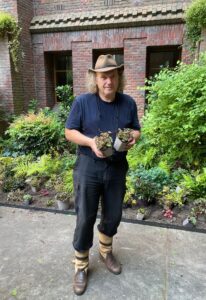
Most of my personal work is with private gardens, but the projects with Blooming Buildings are very different. And planting in cities is crucial. First, because it cools the environment, something badly needed with the increasingly hot summers. Second, drainage: façade gardens and planting beds absorb water, which is essential as flooding becomes more common. Third, people are simply happier in green surroundings. Nature has a huge impact on me—on others, maybe a bit less—but whenever we work somewhere, the reactions are always positive. People are enthusiastic and grateful that we’re creating something beautiful. It makes them feel good.
And of course, there’s biodiversity. I always consider insects, birds, and small mammals. My approach is all-inclusive. I don’t use chemical fertilizers. At most, some natural supplements if needed. I focus on healthy soil life, so plants can develop naturally. After all, the greatest fertilizer is that yellow thing in the sky: the sun drives photosynthesis, producing starch for plants. Biodiversity itself is a natural process. We don’t create biodiversity, but we can create the conditions for it to unfold. And by planting as densely and diversely as I do, that’s exactly what happens. I’ve actually always worked this way. Only now, I do it more consciously.